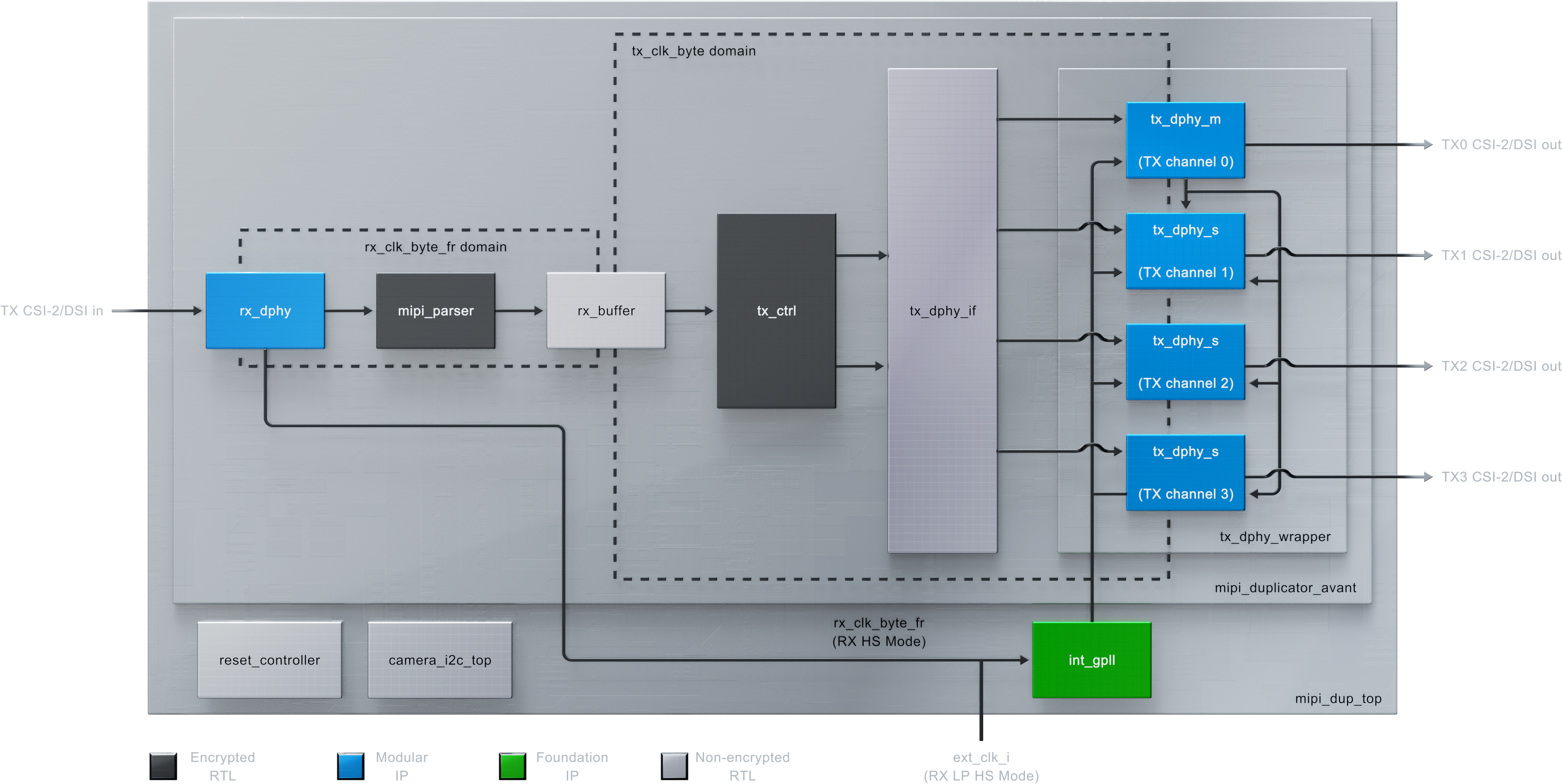
Many new applications such as virtual reality, augmented reality, and digital cameras require expansion of the number of camera or display interface on application processors (AP). This often occurs when there is either not enough ports or some ports are used for other purposes on the AP.
Avant and CertusPro™-NX – The 1 to N MIPI® CSI-2/DSI Duplicator reference design for CertusPro™-NX devices can be configured for one to four duplicated outputs. Lattice Radiant MIPI D-PHY Soft IPs can be configured as MIPI transmitter or receiver utilizing the general DDR modules.
CrossLink™-NX – The 1 to N MIPI CSI-2/DSI Duplicator reference design for CrossLink™-NX devices has one to four-channel outputs for duplicator. It has two MIPI Hardened macro IPs, which can be used as MIPI TX or RX module (D-PHY Hardened IP). The TX and RX modules can also be realized by a soft macro utilizing general DDR modules (D-PHY Soft IP).
CrossLink™ – The 1 to N MIPI CSI-2/DSI Duplicator reference design for CrossLink™ devices has one or two-channel outputs for duplicator. It has two MIPI hard macro IPs, which can be used as MIPI TX or RX module (D-PHY Hard IP). The RX module can also be realized by a soft macro utilizing general DDR modules (D-PHY Soft IP).
Features
- RX channel can have one, two, or four lanes and TX lanes can be one, two, or four. This is independent from the number of RX lanes
- CrossLink and CrossLinkPlus:
- Maximum RX/TX bandwidth is 1.5 Gbps per lane using D-PHY Hard IP and maximum RX bandwidth is 1.2 Gbps per lane using D-PHY Soft IP
- MIPI D-PHY TX is not supported by Soft D-PHY IP and Hard D-PHY IP must be used on TX channel(s)
- CrossLink-NX:
- Maximum RX/TX bandwidth is 2.5 Gbps per lane using D-PHY Hardened IP and 1.5 Gbps per lane using D-PHY Soft IP
- CertusPro-NX:
- Maximum RX/TX bandwidth is 1.5 Gbps per lane using D-PHY Soft IP
- Avant:
- Maximum RX/TX bandwidth is 1.2 Gbps per lane using D-PHY Soft IP