[Blog] Why Rack-Scale AI Needs an Open Control Plane
Posted in
AI infrastructure is no longer built one server at a time. The rack, with its GPUs, CPUs, baseboard management controllers (BMCs), networking interface cards (NICs), and power and cooling systems, has become the unit of compute. But the way the industry secures, updates, and manages that infrastructure hasn’t kept pace. When a single accelerator fails attestation, the impact is felt across the entire rack, and today’s patchwork of vendor-specific tools makes a coordinated response difficult.
That is the case for an Open Control Plane: a unified, standards-based layer that connects management, firmware, and security across the rack, rooted in verifiable hardware. At the Open Compute Project (OCP) Global Summit in San Jose, where the 2026 theme was “Scaling Innovation for the AI Era,” Lattice demonstrated both why the industry needs it and what it should look like.
The Rack is the New Server
The move from primarily server-based operations to rack-level coordination drastically changes management needs. Managing a single device is a different challenge than coordinating a broader system. In a rack-scale model, components are interdependent, so when one element is compromised or fails, the rest of the rack must respond in a consistent, timely, and effective way.
That kind of coordinated response can’t be bolted on later. Security, control, and interface coordination need to be built in at the rack level now, so organizations can avoid unnecessary risk as their AI infrastructure grows.
Defining the Open Control Plane
An Open Control Plane connects the three layers of the rack that today are too often managed in isolation: management and orchestration, platform firmware and control, and trust and security.
It does this through open interfaces, standards, and APIs, all rooted in trusted and verifiable Field Programmable Gate Array (FPGA) hardware. Unlike fixed-function silicon, an FPGA can be reprogrammed after deployment, so the root of trust can adapt as standards evolve and new threats emerge. This matters for racks that must remain in service across multiple hardware generations.
To support coordinated, rack-level response, the control architecture must be built on three principles:
- Secure, with trust rooted below the operating system through a consistent device identity and continuous attestation that maintains trust throughout the infrastructure.
- Resilient, with the ability to detect, update, and recover through a unified, verifiable source, all without taking the cluster offline.
- Efficient, using rack-level power, thermal, and health telemetry as a control loop that lets teams observe the system, set policies, and act quickly.
Why Operators Need an Open Control Plane Now
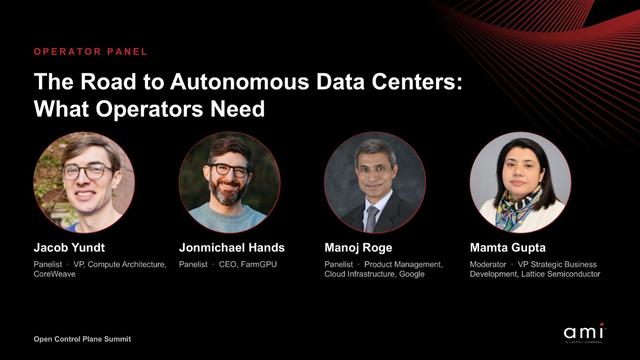
In a panel discussion titled “The Road to Autonomous Datacenters: What Operators Need,” Lattice sat down with leaders from CoreWeave, FarmGPU, and Google to discuss the common pain points operators face as they pursue more capable AI-driven datacenters. The panelists came from different backgrounds and support distinct parts of modern datacenter infrastructure, yet the challenges they described were strikingly similar.
Each challenge points directly to the need for an Open Control Plane.
- Too many management interfaces: A single rack carries GPUs, CPUs, BMCs, NICs, and power and cooling hardware, each with its own management interface. Operators are left to stitch these together as best they can to create consistency across the rack and the broader data center. An Open Control Plane replaces that patchwork with open interfaces, standards, and APIs, giving operators one consistent way to manage the rack.
- Mixed hardware generations: Most fleets span multiple hardware generations and vendors, so keeping firmware current takes extra time. The same bug may reappear across platforms, requiring more testing and revision, causing costly downtime, and delaying new capacity coming online. This is where resilience matters: a unified, verifiable source for detecting issues and pushing updates lets teams recover without taking the cluster offline.
- Trust and attestation: Knowing which firmware is running at any given time is difficult. Attestation is the process by which a device proves its identity and the integrity of its firmware. Attestation tooling differs from vendor to vendor, which creates potential security gaps and can lead to firmware drift, meaning running firmware that diverges from the approved version. A secure control plane addresses this at the root, with consistent device identity established below the operating system and continuous attestation across every component in the rack.
- Limited rack-level visibility: Power, thermal, and health data often sits in separate tools, making it hard to see the state of the rack as a whole or to set policies that act on it. Using rack-level telemetry as a control loop lets teams observe the system, set policies, and act quickly.
Laying Out the Architecture
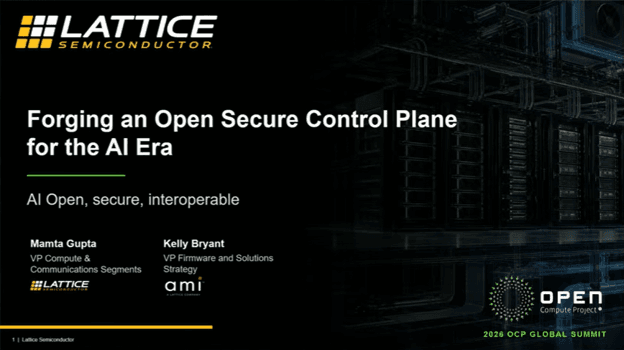
If the panel defined the problem, the Lattice exec session, “Forging an Open Secure Control Plane for the AI Era,” focused on the solution, including the evolving security implications of rack-level AI infrastructure and what unified control architecture needs to deliver.
We explored how the three layers of the rack, from management and orchestration to platform firmware to trust and security, can work together through open standards, and why anchoring that architecture in verifiable hardware is essential.
Building an Open Control Plane takes both trusted hardware and the firmware that brings it to life. Lattice FPGAs provide the hardware foundation, establishing a root of trust below the operating system that can adapt as standards evolve. AMI, a Lattice Company, brings platform firmware and management expertise that connects that foundation to the rest of the rack.
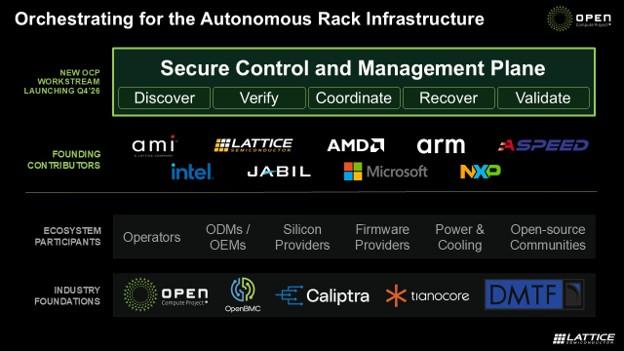
That work is already underway through SCMP, the new Open Compute Project workstream. SCMP is intended to be an open, vendor-neutral architecture for secure control, boot, and management of datacenter infrastructure, defining how trust and control is established and maintained from the silicon root of trust through the rack and pod. It builds on existing industry efforts, including Caliptra™, DMTF SPDM, and OCP S.A.F.E.™, and launches with AMD, AMI, Arm, ASPEED, Intel, Jabil, Lattice, Microsoft, and NXP as founders. Organizations interested in contributing to the workstream can visit the OCP Community webpage for more information.
Building the Future of Rack-scale AI, Together
The shift to rack-scale AI is already underway, and the control plane that supports it needs to be open, secure, and built in from the start. As the conversations at the OCP Global Summit made clear, no single vendor can solve these challenges alone.
Operators need consistent management across mixed hardware, a trusted way to verify what is running in every rack, and the ability to update and recover without taking capacity offline. An Open Control Plane, rooted in verifiable hardware and built on open standards, gives the industry a common foundation to deliver on all three. Lattice and AMI are committed to helping shape that foundation alongside our partners and the broader OCP community.
To discuss how Lattice can help you build secure, resilient, and efficient AI datacenter infrastructure, contact our team today.