[Blog] Closing the Firmware PQC Security Gap in AI InfrastructureBlogEntryPage1cf82f39-2d91-4164-8301-88b878fc7e57Blog/Blog/2026/Closing-the-Firmware-PQC-Security-Gap-in-AI-Infrastructurehttps://edge.sitecorecloud.io/latticesemi9e32-latticesemi06bb-prod9ecc-d341/media/Project/Lattice/LatticeSemi/Images/SearchThumbnails/blog.png?sc_lang=enIn this blog, we discuss the launch of Lattice Sentry 5.0, the industry’s first post-quantum cryptography (PQC)-enabled Platform Firmware Resilience and attestation solution. Built on CNSA 2.0-compliant FPGAs and AMI Tektagon, it secures disaggregated AI infrastructure against firmware attacks and future quantum threats.AI infrastructure is advancing at a pace that is fundamentally reshaping how we build, deploy, and secure compute systems. At the same time, the cryptographic foundations that have protected our platforms for decades are under threat. These two forces are not independent. They are evolving together, and that convergence demands action now. Today, at OCP Global Summit 2026 , we announced Lattice Sentry solution stack (version 5.0): the industry's first post-quantum cryptography (PQC)-enabled Platform Firmware Resilience (PFR) and attestation solution. Lattice Sentry is a production-ready platform that gives system designers a validated path to quantum-resistant security today. AI Infrastructure Is Disaggregating. The Attack Surface Is Growing. The traditional server model where compute, storage, networking, and accelerators were tightly integrated within a single chassis is giving way to something more modular and distributed. Rack-scale, disaggregated AI infrastructure now connects CPUs, GPUs, DPUs, storage pools, and networking fabrics from multiple vendors across a shared fabric. This architecture unlocks the flexibility and scalability that AI workloads demand. But it also widens the control and trust gap. When firmware runs across dozens of discrete devices from different vendors, each with its own management interface, the question of who controls what, and whether any of it can be trusted, becomes urgent. Platform firmware has emerged as a primary attack vector precisely because it sits below the operating system and hypervisor, often outside traditional security tools. A compromised firmware image can persist across reboots, survive OS reinstalls, and undermine the entire security posture of a system. The Quantum Era Is Not Coming. It Is Being Built Into Today's Systems. The intelligence and security communities have been clear: quantum computers capable of breaking classical cryptographic algorithms are not a distant concern. They are a present-day planning requirement. The U.S. National Security Agency issued the Commercial National Security Algorithm Suite 2.0 (CNSA 2.0) mandate, requiring federal systems to transition to PQC-approved algorithms on accelerated timelines. Other industries are following. The challenge is that the systems being designed and deployed today could still be running in five, ten, fifteen or more years. The firmware protection and cryptographic decisions baked into those systems now will determine whether they are defensible in a post-quantum world. Infrastructure teams cannot afford to treat quantum readiness as a future upgrade. It must be part of the architecture from the start. Lattice Sentry: From Silicon to Stack, Built for What's Next Lattice Sentry addresses both challenges together. It is the industry's first solution to combine PQC-enabled PFR with full attestation support across disaggregated rack environments, built on Lattice's CNSA 2.0-compliant FPGA silicon and delivered as a complete, validated platform. At the core of the Sentry stack is a comprehensive set of capabilities designed to protect, detect, and recover platform firmware across the full lifecycle: Platform Firmware Resilience. Sentry delivers NIST SP800-193-compliant protection, detection, and autonomous recovery for BIOS, BMC, and other board firmware. Crypto agility with anti-rollback protection, secure firmware updates, key provisioning and revocation, and secure decommissioning are all built in. Post-Quantum and Classical Cryptography. Sentry supports the full CNSA 2.0 PQC algorithm suite: ML-DSA, LMS, and XMSS for authentication; ML-KEM for key exchange. Classical algorithms including ECDSA and AES-GCM are also supported, enabling a smooth transition for existing deployments. Hardware Attestation and Identity. SPDM-based device attestation extends across servers and rack infrastructure. DICE-anchored cryptographic identity provides supply chain and platform integrity measurement. Multi-device attestation supports the realities of disaggregated rack environments. AMI Tektagon PQC Resiliency. Built on top of Lattice's silicon, AMI Tektagon delivers an end-to-end framework for PQC-enabled provisioning, attestation, firmware updates, and lifecycle management. The pre-validated silicon and software stack accelerates deployment and reduces integration risk. A Leadership Position Built Over Years, Delivered Now Lattice has been building toward this moment. Our Lattice MachXO5 -NX TDQ and Mach -N2 FPGA families are industry-firsts in CNSA 2.0 compliance, establishing the silicon foundation for PQC at the hardware level. Sentry extends that leadership from silicon into a full solution stack, combining Lattice's programmable platform security expertise with AMI's industry-leading firmware and infrastructure management capabilities. This is not an incremental feature update. It is the culmination of a deliberate strategy to be the company that closes the gap between quantum-era security requirements and production-ready deployments. Sentry comes with a fully validated reference platform, a proven IP library, Lattice Radiant and Lattice Propel design tools, and ready-to-run demos. Customers can move from evaluation to production without starting from scratch, now easier and faster than ever thanks to Lattice Prompt , an AI-assisted FPGA development tool enabling designers can work across the full design flow in natural language. The quantum era and the AI era are arriving together. Platform firmware is the common battleground. Lattice Sentry is how Lattice is helping the industry meet that challenge with confidence, and with technology that is ready for tomorrow s challenges now. To learn more about how Lattice Sentry and our PQC-enabled platform security solutions can help secure your AI infrastructure, reach out to our team today.AI infrastructure is advancing at a pace that is fundamentally reshaping how we build, deploy, and secure compute systems. At the same time, the cryptographic foundations that have protected our platforms for decades are under threat. These two forces are not independent. They are evolving together, and that convergence demands action now. Today, at OCP Global Summit 2026 , we announced Lattice Sentry solution stack (version 5.0): the industry's first post-quantum cryptography (PQC)-enabled Platform Firmware Resilience (PFR) and attestation solution. Lattice Sentry is a production-ready platform that gives system designers a validated path to quantum-resistant security today. AI Infrastructure Is Disaggregating. The Attack Surface Is Growing. The traditional server model where compute, storage, networking, and accelerators were tightly integrated within a single chassis is giving way to something more modular and distributed. Rack-scale, disaggregated AI infrastructure now connects CPUs, GPUs, DPUs, storage pools, and networking fabrics from multiple vendors across a shared fabric. This architecture unlocks the flexibility and scalability that AI workloads demand. But it also widens the control and trust gap. When firmware runs across dozens of discrete devices from different vendors, each with its own management interface, the question of who controls what, and whether any of it can be trusted, becomes urgent. Platform firmware has emerged as a primary attack vector precisely because it sits below the operating system and hypervisor, often outside traditional security tools. A compromised firmware image can persist across reboots, survive OS reinstalls, and undermine the entire security posture of a system. The Quantum Era Is Not Coming. It Is Being Built Into Today's Systems. The intelligence and security communities have been clear: quantum computers capable of breaking classical cryptographic algorithms are not a distant concern. They are a present-day planning requirement. The U.S. National Security Agency issued the Commercial National Security Algorithm Suite 2.0 (CNSA 2.0) mandate, requiring federal systems to transition to PQC-approved algorithms on accelerated timelines. Other industries are following. The challenge is that the systems being designed and deployed today could still be running in five, ten, fifteen or more years. The firmware protection and cryptographic decisions baked into those systems now will determine whether they are defensible in a post-quantum world. Infrastructure teams cannot afford to treat quantum readiness as a future upgrade. It must be part of the architecture from the start. Lattice Sentry: From Silicon to Stack, Built for What's Next Lattice Sentry addresses both challenges together. It is the industry's first solution to combine PQC-enabled PFR with full attestation support across disaggregated rack environments, built on Lattice's CNSA 2.0-compliant FPGA silicon and delivered as a complete, validated platform. At the core of the Sentry stack is a comprehensive set of capabilities designed to protect, detect, and recover platform firmware across the full lifecycle: Platform Firmware Resilience. Sentry delivers NIST SP800-193-compliant protection, detection, and autonomous recovery for BIOS, BMC, and other board firmware. Crypto agility with anti-rollback protection, secure firmware updates, key provisioning and revocation, and secure decommissioning are all built in. Post-Quantum and Classical Cryptography. Sentry supports the full CNSA 2.0 PQC algorithm suite: ML-DSA, LMS, and XMSS for authentication; ML-KEM for key exchange. Classical algorithms including ECDSA and AES-GCM are also supported, enabling a smooth transition for existing deployments. Hardware Attestation and Identity. SPDM-based device attestation extends across servers and rack infrastructure. DICE-anchored cryptographic identity provides supply chain and platform integrity measurement. Multi-device attestation supports the realities of disaggregated rack environments. AMI Tektagon PQC Resiliency. Built on top of Lattice's silicon, AMI Tektagon delivers an end-to-end framework for PQC-enabled provisioning, attestation, firmware updates, and lifecycle management. The pre-validated silicon and software stack accelerates deployment and reduces integration risk. A Leadership Position Built Over Years, Delivered Now Lattice has been building toward this moment. Our Lattice MachXO5 -NX TDQ and Mach -N2 FPGA families are industry-firsts in CNSA 2.0 compliance, establishing the silicon foundation for PQC at the hardware level. Sentry extends that leadership from silicon into a full solution stack, combining Lattice's programmable platform security expertise with AMI's industry-leading firmware and infrastructure management capabilities. This is not an incremental feature update. It is the culmination of a deliberate strategy to be the company that closes the gap between quantum-era security requirements and production-ready deployments. Sentry comes with a fully validated reference platform, a proven IP library, Lattice Radiant and Lattice Propel design tools, and ready-to-run demos. Customers can move from evaluation to production without starting from scratch, now easier and faster than ever thanks to Lattice Prompt , an AI-assisted FPGA development tool enabling designers can work across the full design flow in natural language. The quantum era and the AI era are arriving together. Platform firmware is the common battleground. Lattice Sentry is how Lattice is helping the industry meet that challenge with confidence, and with technology that is ready for tomorrow s challenges now. To learn more about how Lattice Sentry and our PQC-enabled platform security solutions can help secure your AI infrastructure, reach out to our team today.FPGA, post-quantum cryptography, PQC, platform firmware resilience, PFR, Lattice Sentry, CNSA 2.0, AMI Tektagon, SPDM attestation, firmware attestation, disaggregated AI infrastructure2026-10-12T13:00:00Z
[Blog] Closing the Firmware PQC Security Gap in AI Infrastructure
Posted 10/12/2026 by Lattice Semiconductor
AI infrastructure is advancing at a pace that is fundamentally reshaping how we build, deploy, and secure compute systems. At the same time, the cryptographic foundations that have protected our platforms for decades are under threat. These two forces are not independent. They are evolving together, and that convergence demands action now.
Today, at OCP Global Summit 2026, we announced Lattice Sentry solution stack (version 5.0): the industry's first post-quantum cryptography (PQC)-enabled Platform Firmware Resilience (PFR) and attestation solution. Lattice Sentry is a production-ready platform that gives system designers a validated path to quantum-resistant security today.
AI Infrastructure Is Disaggregating. The Attack Surface Is Growing.
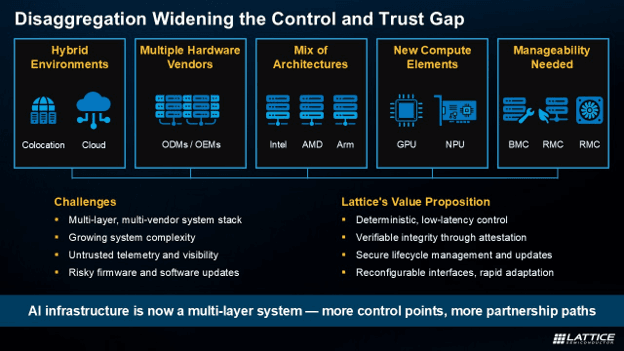
The traditional server model where compute, storage, networking, and accelerators were tightly integrated within a single chassis is giving way to something more modular and distributed. Rack-scale, disaggregated AI infrastructure now connects CPUs, GPUs, DPUs, storage pools, and networking fabrics from multiple vendors across a shared fabric. This architecture unlocks the flexibility and scalability that AI workloads demand.
But it also widens the control and trust gap. When firmware runs across dozens of discrete devices from different vendors, each with its own management interface, the question of who controls what, and whether any of it can be trusted, becomes urgent. Platform firmware has emerged as a primary attack vector precisely because it sits below the operating system and hypervisor, often outside traditional security tools. A compromised firmware image can persist across reboots, survive OS reinstalls, and undermine the entire security posture of a system.
The Quantum Era Is Not Coming. It Is Being Built Into Today's Systems.
The intelligence and security communities have been clear: quantum computers capable of breaking classical cryptographic algorithms are not a distant concern. They are a present-day planning requirement. The U.S. National Security Agency issued the Commercial National Security Algorithm Suite 2.0 (CNSA 2.0) mandate, requiring federal systems to transition to PQC-approved algorithms on accelerated timelines. Other industries are following.
The challenge is that the systems being designed and deployed today could still be running in five, ten, fifteen or more years. The firmware protection and cryptographic decisions baked into those systems now will determine whether they are defensible in a post-quantum world. Infrastructure teams cannot afford to treat quantum readiness as a future upgrade. It must be part of the architecture from the start.
Lattice Sentry: From Silicon to Stack, Built for What's Next
Lattice Sentry addresses both challenges together. It is the industry's first solution to combine PQC-enabled PFR with full attestation support across disaggregated rack environments, built on Lattice's CNSA 2.0-compliant FPGA silicon and delivered as a complete, validated platform.
At the core of the Sentry stack is a comprehensive set of capabilities designed to protect, detect, and recover platform firmware across the full lifecycle:
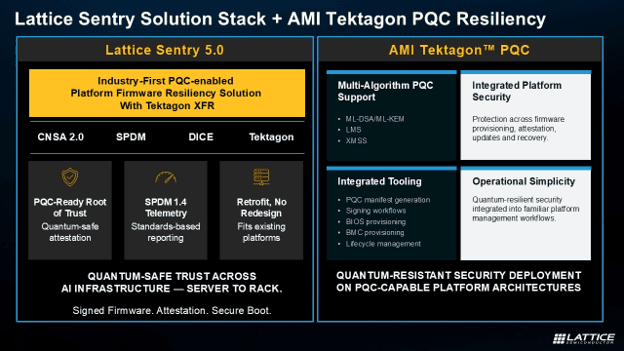
- Platform Firmware Resilience. Sentry delivers NIST SP800-193-compliant protection, detection, and autonomous recovery for BIOS, BMC, and other board firmware. Crypto agility with anti-rollback protection, secure firmware updates, key provisioning and revocation, and secure decommissioning are all built in.
- Post-Quantum and Classical Cryptography. Sentry supports the full CNSA 2.0 PQC algorithm suite: ML-DSA, LMS, and XMSS for authentication; ML-KEM for key exchange. Classical algorithms including ECDSA and AES-GCM are also supported, enabling a smooth transition for existing deployments.
- Hardware Attestation and Identity. SPDM-based device attestation extends across servers and rack infrastructure. DICE-anchored cryptographic identity provides supply chain and platform integrity measurement. Multi-device attestation supports the realities of disaggregated rack environments.
- AMI Tektagon PQC Resiliency. Built on top of Lattice's silicon, AMI Tektagon™ delivers an end-to-end framework for PQC-enabled provisioning, attestation, firmware updates, and lifecycle management. The pre-validated silicon and software stack accelerates deployment and reduces integration risk.
A Leadership Position Built Over Years, Delivered Now
Lattice has been building toward this moment. Our Lattice MachXO5™-NX TDQ and Mach™-N2 FPGA families are industry-firsts in CNSA 2.0 compliance, establishing the silicon foundation for PQC at the hardware level. Sentry extends that leadership from silicon into a full solution stack, combining Lattice's programmable platform security expertise with AMI's industry-leading firmware and infrastructure management capabilities.
This is not an incremental feature update. It is the culmination of a deliberate strategy to be the company that closes the gap between quantum-era security requirements and production-ready deployments. Sentry comes with a fully validated reference platform, a proven IP library, Lattice Radiant® and Lattice Propel™ design tools, and ready-to-run demos. Customers can move from evaluation to production without starting from scratch, now easier and faster than ever thanks to Lattice Prompt™, an AI-assisted FPGA development tool enabling designers can work across the full design flow in natural language.
The quantum era and the AI era are arriving together. Platform firmware is the common battleground. Lattice Sentry is how Lattice is helping the industry meet that challenge with confidence, and with technology that is ready for tomorrow’s challenges now.
To learn more about how Lattice Sentry and our PQC-enabled platform security solutions can help secure your AI infrastructure, reach out to our team today.