[Blog] Upgrade Security Without a Redesign: An Introduction to Security RetrofitBlogEntryPagec60492a2-f385-4a45-badc-1460fc94649fBlog/Blog/2026/11/Upgrade-Security-Without-a-Redesign-An-Introduction-to-Security-Retrofithttps://edge.sitecorecloud.io/latticesemi9e32-latticesemi06bb-prod9ecc-d341/media/Project/Lattice/LatticeSemi/Images/SearchThumbnails/blog.png?sc_lang=enIn this blog, we discuss how a security retrofit can add a hardware root of trust, secure boot, and post-quantum cryptography to servers and other platforms already designed or deployed, avoiding costly redesigns. Using a programmable Lattice FPGA, the approach protects, detects, and recovers firmware per NIST SP 800-193 and supports SPDM-based attestation, while remaining updatable as standards and regulations evolve.In this blog, we discuss how a security retrofit can add a hardware root of trust, secure boot, and post-quantum cryptography to servers and other platforms already designed or deployed, avoiding costly redesigns. Using a programmable Lattice FPGA, the approach protects, detects, and recovers firmware per NIST SP 800-193 and supports SPDM-based attestation, while remaining updatable as standards and regulations evolve.Project > Lattice > LatticeSemi > Images > Blogs > 2026 (Alt text: "Upgrade security without a redesign: security retrofit") ================================================================== PASTE EVERYTHING BELOW THIS COMMENT INTO THE RICH TEXT "BODY" FIELD (Edit HTML view) Bullets: plain . The site stylesheet adds the Lattice Yellow square automatically. ================================================================== --> Many of the servers, switches, and controllers running today s infrastructure were designed before post-quantum cryptography (PQC) standards, platform firmware resilience requirements, or the EU Cyber Resilience Act (CRA) existed. Many will remain in service for another decade. Replacing them all is not realistic, and leaving them exposed is not acceptable. Security retrofit offers a third path. Why Action Is Needed Now Security is shifting from a product feature to a condition of purchase. Three forces are driving this: The quantum threat: Quantum computers will eventually be able to break the encryption that protects data and firmware today. Adversaries may already be collecting encrypted data to decrypt later, so long-life platforms are exposed now. Published compliance: NIST has published PQC standards, including FIPS 203 (ML-KEM) and FIPS 204 (ML-DSA), along with SP 800-208 and SP 800-193 . CNSA 2.0 sets a transition schedule for national security systems, and the EU Cyber Resilience Act sets obligations for products with digital elements. Multi-vendor attestation: Modern racks combine trays, cards, and silicon from many suppliers. Every component must prove it is genuine before the platform is trusted, and SPDM-based attestation is the protocol used to do so. A Practical Path Between Redesign and Risk Security retrofit adds a hardware root of trust, secure boot, and quantum-resistant cryptography to platforms that are already designed or deployed. A pre-validated module solution in a standard M.2 connector provides an easy upgrade path to an existing system, so the platform change is limited to integrating the device. The advantages are as follows: Speed and cost: A retrofit solution is typically faster and less costly than a full redesign and re-qualification. Continuity: The main processor, software, proven designs, and supply chains stay in place. Crypto agility: A programmable device can be updated as new standards emerge, so protection keeps pace without replacing the platform. How It Works: Protect, Detect, Recover The Lattice FPGA is the first device to power on, before the BMC and host processor run. It controls access to the flash that stores their firmware and, following the NIST SP 800-193 platform firmware resiliency model, performs three functions: Protect: Authenticates BIOS and BMC firmware before it runs, and accepts only signed images. Detect: Monitors the flash paths in real time to catch unauthorized changes or active attacks. Recover: Restores a known-good firmware image if a failure or compromise is detected. The same root of trust supports attestation. Using SPDM and DICE-based device identity, a platform can prove to a remote verifier that it is genuine and unmodified. Why a Programmable Root of Trust Fixed-function security is locked in at manufacture, while a Lattice FPGA can be updated in the field as standards and threats change. For new platforms, designing crypto agility in from the start remains the best approach, with a Lattice FPGA placed directly on the board. Security retrofit extends the same agility to platforms already designed or deployed. In both cases, when algorithms change, the security device or its configuration is updated, not the platform, reducing the likelihood that today s retrofit will require another one tomorrow. The Lattice Building Blocks Lattice secure control FPGAs, including Mach -N2 , MachXO5 -NX TDQ , Mach -NX , and MachXO3D , provide a hardware root of trust, secure boot, and authenticated update aligned with the NIST SP 800-193 and CNSA 2.0-compliant PQC support. AMI Tektagon firmware provides the platform root-of-trust orchestration and firmware protection, including PQC-signed image support. The Lattice Sentry solution stack provides software, reference designs, and tools to accelerate deployment in existing platforms. Version 5.0 adds PQC to firmware resilience and attestation. Beyond the Data Center Security retrofit began with data center platforms operators securing servers already in service. The same approach applies well beyond them, to any system that combines a long service life with rising regulatory expectations: Communications and industrial systems: Platforms with expensive, long-life silicon can gain PQC protection without being re-taped out. Equipment makers selling globally: A trusted root of trust, with PQC, firmware resilience, and attestation, supports the supply-chain trust expected by US and EU buyers. Automotive, aerospace, and defense: Systems that must meet strict security requirements throughout very long service lives. Explore Lattice FPGA Security Solutions for the full portfolio, or visit Lattice Data Center Solutions to see secure, adaptable control and management for AI infrastructure. For product details and evaluation hardware, please contact our team today.FPGA, Security retrofit, PQC, PFR, platform firmware, EU CRA, SPDM, Root of Trust, HRoT, datacenter security2026-11-20T13:00:00Z
[Blog] Upgrade Security Without a Redesign: An Introduction to Security Retrofit
Posted 11/20/2026 by Lattice Semiconductor
Many of the servers, switches, and controllers running today’s infrastructure were designed before post-quantum cryptography (PQC) standards, platform firmware resilience requirements, or the EU Cyber Resilience Act (CRA) existed. Many will remain in service for another decade.
Replacing them all is not realistic, and leaving them exposed is not acceptable. Security retrofit offers a third path.
Why Action Is Needed Now
Security is shifting from a product feature to a condition of purchase. Three forces are driving this:
- The quantum threat: Quantum computers will eventually be able to break the encryption that protects data and firmware today. Adversaries may already be collecting encrypted data to decrypt later, so long-life platforms are exposed now.
- Published compliance: NIST has published PQC standards, including FIPS 203 (ML-KEM) and FIPS 204 (ML-DSA), along with SP 800-208 and SP 800-193. CNSA 2.0 sets a transition schedule for national security systems, and the EU Cyber Resilience Act sets obligations for products with digital elements.
- Multi-vendor attestation: Modern racks combine trays, cards, and silicon from many suppliers. Every component must prove it is genuine before the platform is trusted, and SPDM-based attestation is the protocol used to do so.
A Practical Path Between Redesign and Risk
Security retrofit adds a hardware root of trust, secure boot, and quantum-resistant cryptography to platforms that are already designed or deployed. A pre-validated module solution in a standard M.2 connector provides an easy upgrade path to an existing system, so the platform change is limited to integrating the device.
The advantages are as follows:
- Speed and cost: A retrofit solution is typically faster and less costly than a full redesign and re-qualification.
- Continuity: The main processor, software, proven designs, and supply chains stay in place.
- Crypto agility: A programmable device can be updated as new standards emerge, so protection keeps pace without replacing the platform.
How It Works: Protect, Detect, Recover
The Lattice FPGA is the first device to power on, before the BMC and host processor run. It controls access to the flash that stores their firmware and, following the NIST SP 800-193 platform firmware resiliency model, performs three functions:
- Protect: Authenticates BIOS and BMC firmware before it runs, and accepts only signed images.
- Detect: Monitors the flash paths in real time to catch unauthorized changes or active attacks.
- Recover: Restores a known-good firmware image if a failure or compromise is detected.
The same root of trust supports attestation. Using SPDM and DICE-based device identity, a platform can prove to a remote verifier that it is genuine and unmodified.
Why a Programmable Root of Trust
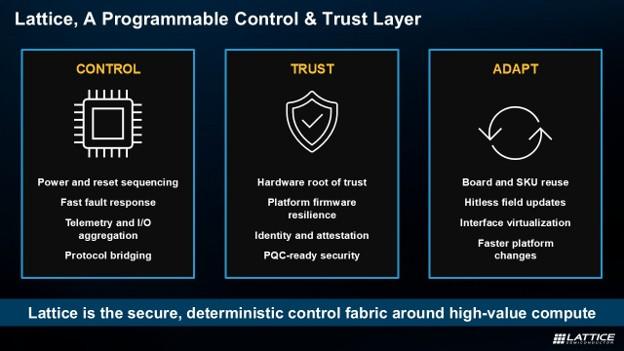
Fixed-function security is locked in at manufacture, while a Lattice FPGA can be updated in the field as standards and threats change. For new platforms, designing crypto agility in from the start remains the best approach, with a Lattice FPGA placed directly on the board.
Security retrofit extends the same agility to platforms already designed or deployed. In both cases, when algorithms change, the security device or its configuration is updated, not the platform, reducing the likelihood that today’s retrofit will require another one tomorrow.
The Lattice Building Blocks
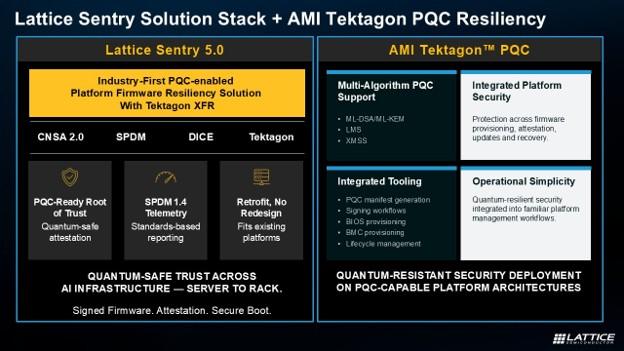
- Lattice secure control FPGAs, including Mach™-N2, MachXO5™-NX TDQ, Mach™-NX, and MachXO3D™, provide a hardware root of trust, secure boot, and authenticated update aligned with the NIST SP 800-193 and CNSA 2.0-compliant PQC support.
- AMI Tektagon™ firmware provides the platform root-of-trust orchestration and firmware protection, including PQC-signed image support.
- The Lattice Sentry™ solution stack provides software, reference designs, and tools to accelerate deployment in existing platforms. Version 5.0 adds PQC to firmware resilience and attestation.
Beyond the Data Center
Security retrofit began with data center platforms operators securing servers already in service. The same approach applies well beyond them, to any system that combines a long service life with rising regulatory expectations:
- Communications and industrial systems: Platforms with expensive, long-life silicon can gain PQC protection without being re-taped out.
- Equipment makers selling globally: A trusted root of trust, with PQC, firmware resilience, and attestation, supports the supply-chain trust expected by US and EU buyers.
- Automotive, aerospace, and defense: Systems that must meet strict security requirements throughout very long service lives.
Explore Lattice FPGA Security Solutions for the full portfolio, or visit Lattice Data Center Solutions to see secure, adaptable control and management for AI infrastructure.
For product details and evaluation hardware, please contact our team today.